San Gimignano
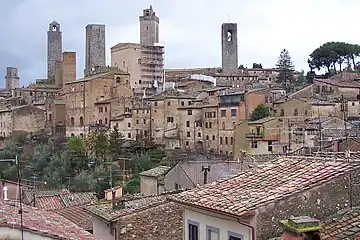
San Gimignano is a small hill town in the province of Siena, Tuscany, Italy. San Gimignano is famous for the Middle Ages towers, and for the wine, called "Vernaccia di San Gimignano".
History
San Gimignano was founded as a small village in about 1300 BC by the Etruscans. The name of the city come from by a saint, Saint Geminianus, who had defended it from Attila's Huns.
In medieval (Middle Ages) and Renaissance times, it was a stopping point for pilgrims on their way to Rome and the Vatican City as it sits on the medieval via Francigena.
In 1199, during the period of its highest splendour, the city made itself independent from Volterra.
Important places
There are many churches in the town: the two main ones are the Collegiata, a cathedral, and Sant'Agostino.
The Communal Palace is now the home of San Gimignano Gallery. Hhere there are works by Pinturicchio, Benozzo Gozzoli, Filippino Lippi, Domenico di Michelino, Pier Francesco Fiorentino, and others.
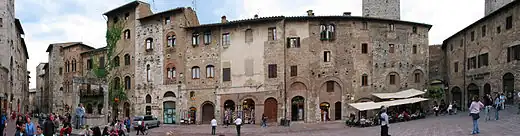
The heart of the town contains the four squares, "Piazza della Cisterna", "Piazza Duomo", "Piazza Pecori", and "Piazza delle Erbe".
Culture
San Gimignano is the birthplace of the poet Folgore da San Gimignano (1270-1332).
Tea with Mussolini, a 1999 drama about English and American women in Italy during World War II, was filmed in part at San Gimignano.
Images
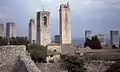 The towers of San Gimignano
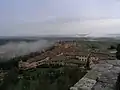 San Gimignano
 View of San Gimignano, Italy, from the Torre Grossa (the Big Tower)
 Veiw from the Torre Grossa
_(10E).svg.png.webp) |
Geography Portal — Everything about geography, continents, regions, geology, water and climate... |